ZEELCHEM DF (SILICONE BASE DEFOAMER)
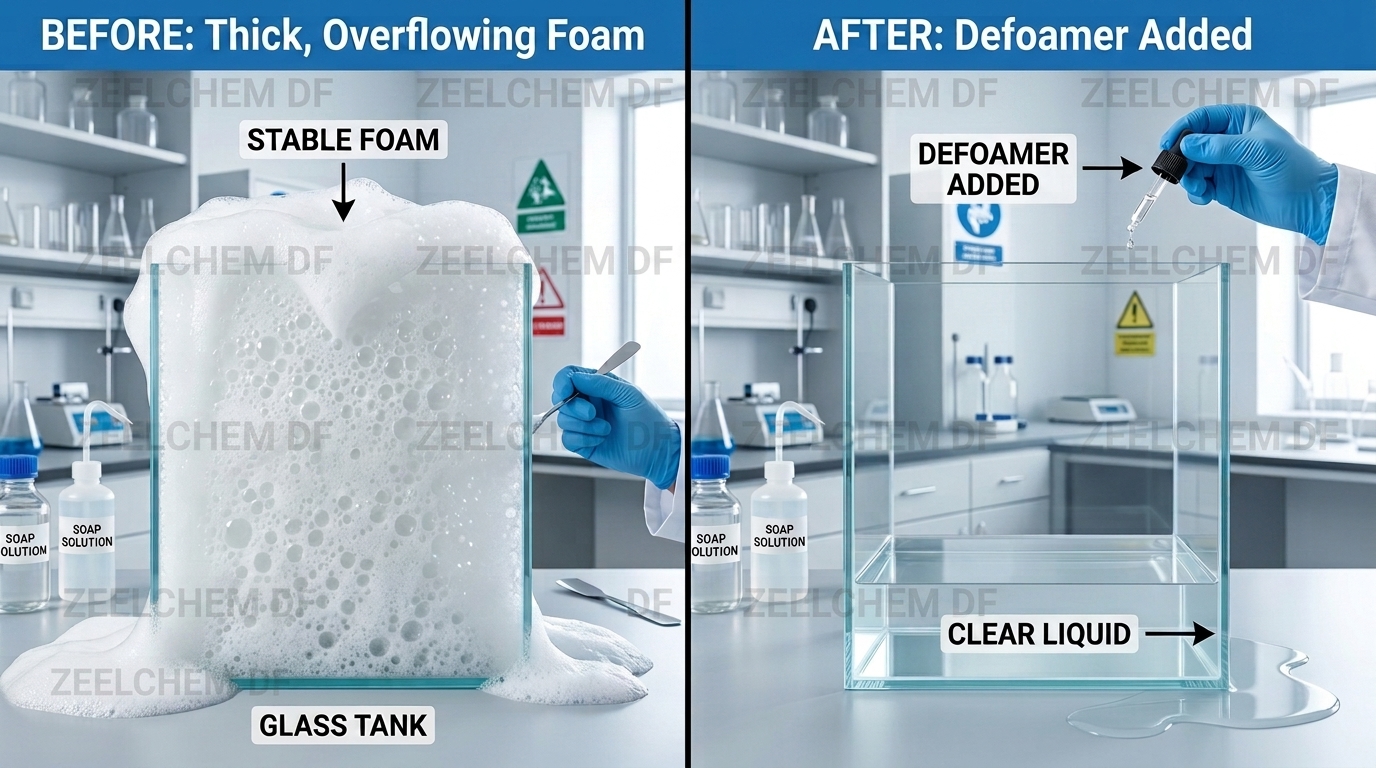
Silicone defoamers—most of them are based on polydimethylsiloxane (PDMS), sometimes combined with hydrophobic silica—are some of the most popular foam-control agents out there. They’re a go-to for a reason, especially in tough industrial jobs, but they’re not perfect for every situation.
Advantages and Disadvantages of Silicone Defoamers:
| Advantage | Details |
|---|---|
| High efficiency at low dosage | Effective at very low concentrations (typically 10–200 ppm active, sometimes as low as 1–10 ppm). This often makes them cost-effective despite a higher price per kilogram. |
| Rapid knockdown + long persistence | Spreads extremely quickly due to very low surface tension (~20–21 mN/m). Breaks existing foam fast and provides lasting suppression. |
| Excellent thermal stability | Performs well at high temperatures (stable long-term around 150°C; short-term exposure can reach much higher). Outperforms many organic alternatives that degrade above ~80–100°C. |
| Broad chemical resistance | Stable across wide pH ranges (often 0–14) and resistant to acids, alkalis, and salts. Suitable for harsh process conditions. |
| Versatile compatibility | Works in both aqueous and many non-aqueous systems. Available as emulsions, compounds, fluids, or powders. |
| Chemical inertness | Generally non-reactive and non-toxic. High-purity / food-grade versions are approved for food, beverage, pharmaceutical, and personal-care uses. |
| Good dispersibility | Modern emulsion grades disperse readily and act quickly throughout the system. |
These strengths make silicone defoamers the preferred choice in wastewater treatment, chemical processing, textiles, pulp & paper, oil & gas, and many high-temperature or high-shear processes.
Disadvantages
| Disadvantage | Details |
|---|---|
| Potential surface defects | Residual silicone can cause cratering, fish-eyes, poor wetting, or recoatability problems in paints, coatings, and inks. It may also affect printability in paper applications. |
| Higher unit cost | Silicone products usually cost more per kilogram than mineral-oil or basic polyether defoamers (though total cost-in-use is often lower due to reduced dosage). |
| Not suitable for all “silicone-free” requirements | Some high-end coatings, electronics, certain adhesives, or strict regulatory processes prohibit or limit silicone. Silicone-free alternatives are required in these cases. |
| Risk of over-dosing issues | Excessive amounts or poorly chosen grades can lead to surface defects, reduced adhesion, or other formulation problems. |
| Limited performance in some systems | In highly compatible or certain surfactant-rich systems, silicones may be less persistent than specialized polyether or organic defoamers. Wrong grade selection can also reduce effectiveness. |
| Handling & formulation sensitivity | Emulsions can be shear-sensitive or require proper dilution/dispersion. Some grades may separate or lose activity if stored or dosed incorrectly. |
Summary: When to Choose Silicone Defoamers
Use silicone when you need fast action, low dosage, high-temperature or extreme-pH performance, and broad process reliability. Consider silicone-free alternatives (mineral oil, polyether, vegetable oil, etc.) when surface quality is critical (coatings, printing), silicone is restricted, or maximum compatibility without residue risk is required.
The best choice always depends on the specific foaming system, operating conditions, and end-product requirements. Lab testing with your actual process media is strongly recommended before full-scale adoption.