SILICONE DEFOAMER (ZEELCHEM DF)
Silicone defoamers, often referred to as silicone antifoams, are primarily made from polydimethylsiloxane (which is silicone oil) mixed with hydrophobic silica. You’ll usually find them in the form of pure silicone compounds, pastes, or, more commonly, water-based emulsions. This makes them easier to handle and dose in various industrial settings like pulp and paper production, wastewater treatment, paint manufacturing, food processing, and chemical operations. The process of making these defoamers typically starts with creating an active silicone-silica compound, often known as silicone paste or defoamer concentrate. This is then emulsified for products that are in emulsion form. The specific formulations, ratios, temperatures, and catalysts used are usually proprietary and can differ from one manufacturer to another, depending on the intended use—like whether it’s for food-grade applications or industrial purposes. Below, you’ll find a general overview based on common industrial practices and methods described in patents.
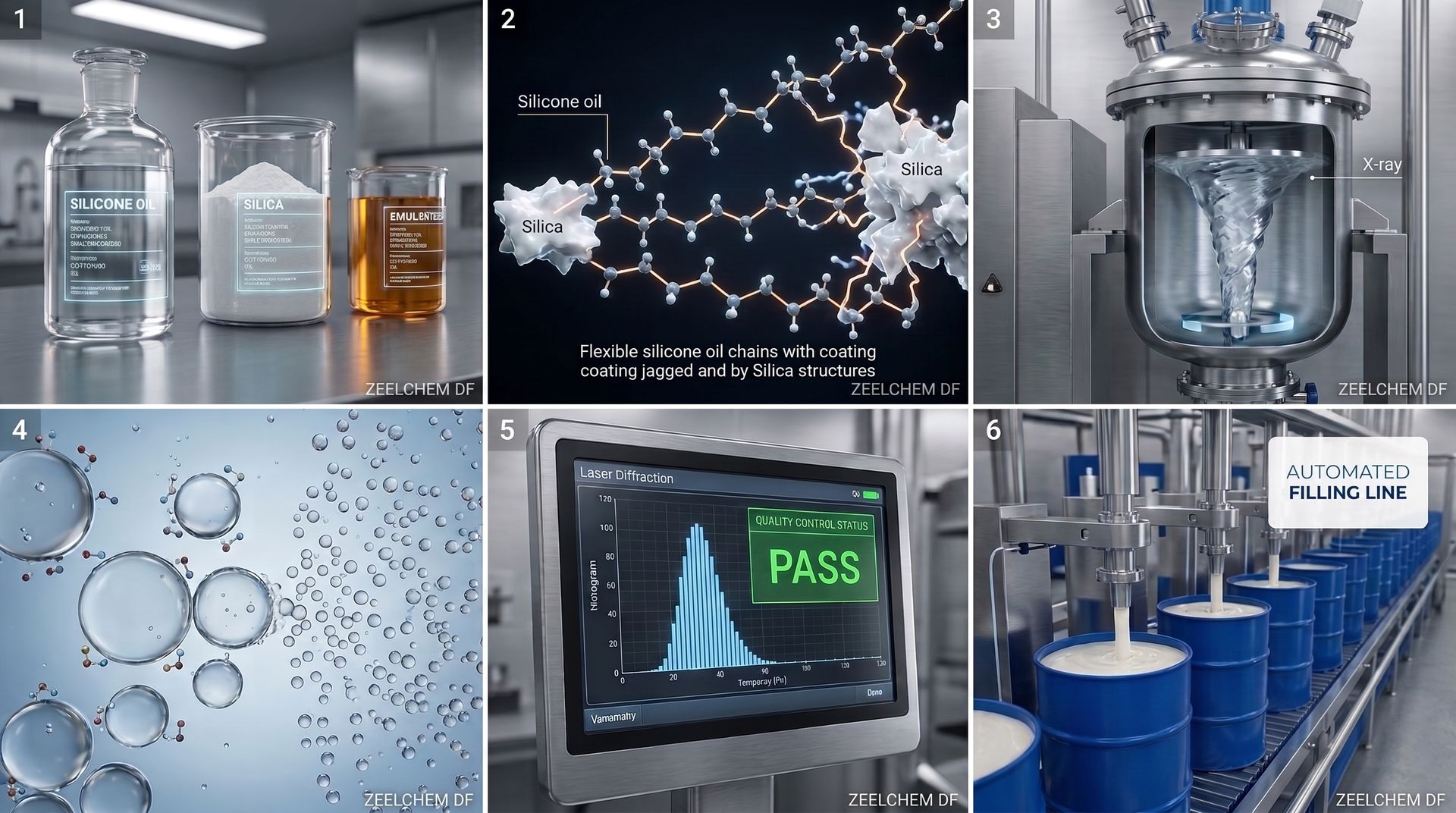
1. Raw Materials (silicone defoamer manufacturing process)
The main ingredient here is Dimethyl silicone oil (polydimethylsiloxane), which comes in a range of viscosities from 100 to 100,000 cSt. Sometimes, you might find hydroxyl-terminated or modified silicones in the mix. For fillers or hydrophobic agents, we typically use fumed (pyrogenic) or precipitated silica, which is often treated to be hydrophobic on-site, usually making up just a few percent of the total weight. Emulsifiers are non-ionic surfactants like blends of Span (sorbitan esters) and Tween (polysorbates) that are tailored to match the HLB value; occasionally, you’ll see polyether-modified silicones as well. Other additives can include thickeners (like CMC, PVA, or acrylic polymers), stabilizers, preservatives (such as sodium benzoate), pH adjusters, solvents or carriers, and sometimes even catalysts or modifiers. And of course, water is used as the continuous phase for emulsions.
2. Preparation of Silicone Paste / Active Compound
This is where the magic happens for our defoaming component: Start by charging the silicone oil(s) into a reactor or mixer. Next, add the silica along with any modifiers or catalysts while stirring. Heat the mixture (usually between 80 and 210 °C, often around 120 to 160 °C) and keep stirring for anywhere from 1 to 6 hours, or even longer. This process allows the silica to become hydrophobized and evenly dispersed, which significantly enhances its ability to spread and break foam. Just mixing it without heat or reaction won’t yield nearly as effective results. Once that’s done, cool down the resulting paste or compound. In some cases, the hydrophilic silica is modified separately (for instance, using silicone oil and a base catalyst in a solvent, followed by washing or distillation) before it’s mixed into the silicone oil and homogenized.
3. Emulsification (for Emulsion-Type Defoamers)
Most commercial products are oil-in-water emulsions: Start by dissolving your emulsifier(s) in the oil or paste phase, or you can prepare separate oil and water phases. Heat everything up to around 50–70 °C and mix it until it’s nice and uniform. Next, prepare your aqueous phase, which includes water and any optional thickener, and heat it to a similar temperature. Now, it’s time to combine the phases—usually, you’ll add the oil into the water, or you might use phase-inversion methods. This should be done under high-shear mixing or homogenization, running at about 1,500–3,000+ rpm for 15–30+ minutes to create those fine, stable droplets. Once that’s done, cool the mixture down and add in your preservatives, thickeners, and pH adjusters (aiming for a pH of around 6–8). If necessary, give it another round of homogenization. Let it sit for a bit, then conduct some quality tests to check for stability under heat and storage, particle size, and defoaming performance through shake or sparge tests.
4. Post-Treatment, Quality Control & Packaging
Adjust the viscosity, active content (typically around 10–30%+ silicone for emulsions), and any other properties you need to tweak. Conduct stability testing to ensure there’s no separation after storing at elevated temperatures. When it comes to packaging, you’ll typically use drums, IBCs, and so on. Pure silicone fluids or compounds can be diluted or used as they are, while emulsions are either ready-to-use or can be further diluted right at the point of application.
Key Process Notes
- Equipment: You’ll need reactors or mixers with temperature control, high-shear mixers or homogenizers, and sometimes high-pressure homogenizers.
- Critical factors: The quality of silica hydrophobization and dispersion, the selection and ratio of emulsifiers, shear conditions, and temperature control all play a significant role in performance and emulsion stability.
- There are variations for solvent-based, powder, or self-emulsifying types, as well as specialized grades (like those using polyether-modified silicones or different fillers).
In industrial production, similar principles apply but on a larger scale, with precise process control to ensure consistency. Keep in mind that specific commercial recipes are often protected