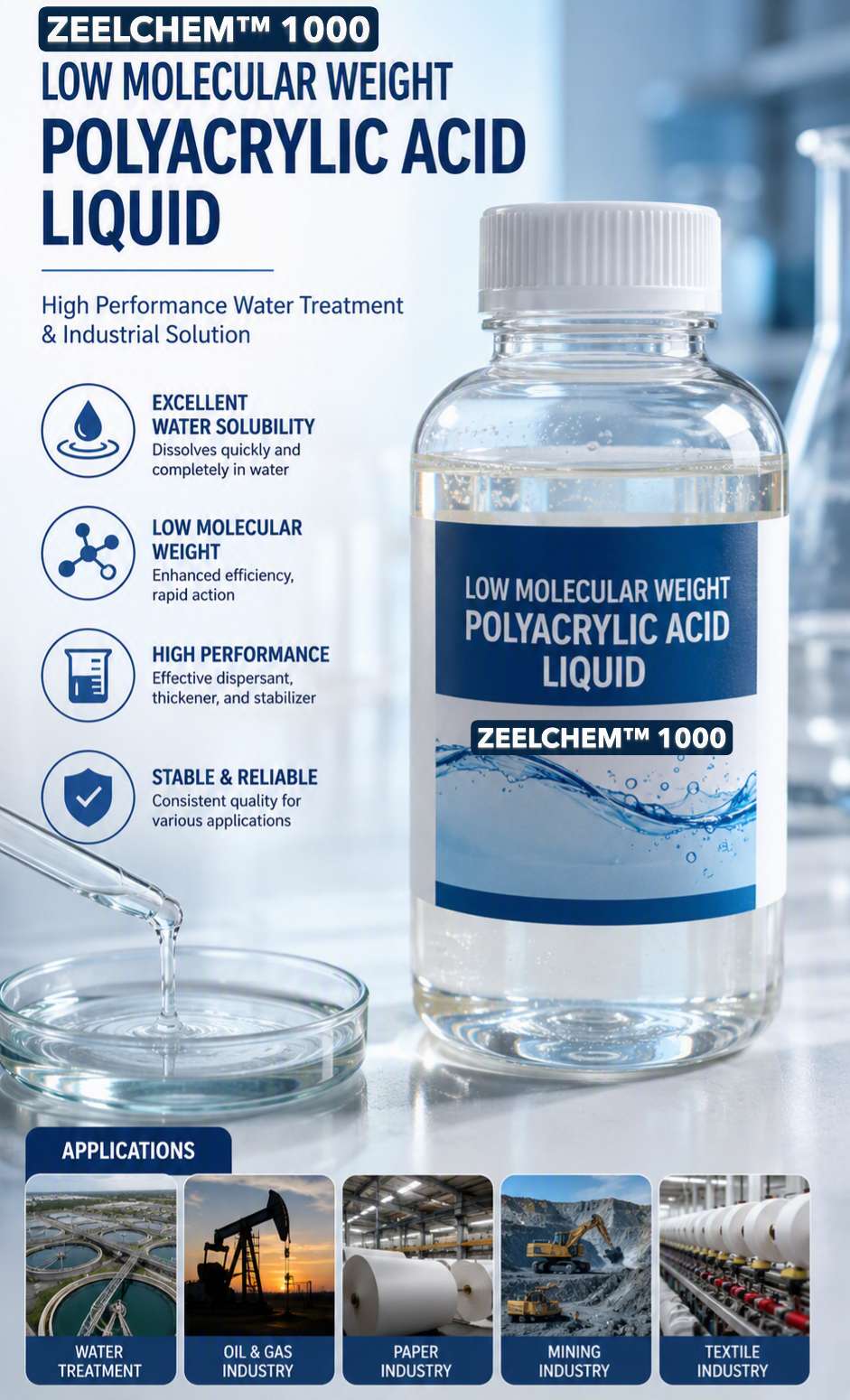
In industrial water treatment, selecting the right polymer is not just about the chemical composition; it is fundamentally about the molecular weight (MW) . While both Low Molecular Weight (LMW) and High Molecular Weight (HMW) polyacrylic acid (PAA) are polymers, they function through distinct mechanisms due to their chain length and physical behavior.
The Mechanism of Scale Inhibition: Threshold Effect vs. Flocculation
The difference in performance between LMW and HMW polymers is driven by how they interact with scale-forming ions and particles.
| Feature | LMW PAA (1,000–5,000 g/mol1,000–5,000 g/mol) | HMW PAA (>100,000 g/mol>100,000 g/mol) |
|---|---|---|
| Primary Action | Threshold Inhibition & Crystal Distortion | Flocculation & Coagulation |
| Mechanism | Adsorption onto crystal nuclei | Bridging between particles |
| Target | Dissolved ions (preventing crystal growth) | Suspended solids (settling/removal) |
| Application | Cooling towers, boilers, RO systems | Wastewater treatment, clarification |
Why LMW PAA Dominates Scale Inhibition
For scale inhibition, smaller is better. Here is the technical breakdown of why LMW PAA is the industry standard for preventing scale:
1. Threshold Inhibition (Crystal Growth Interference)
LMW PAA molecules are small enough to reach and adsorb onto the active growth sites of sub-microscopic crystal nuclei (like CaCO3CaCO3). By blocking these sites, the polymer prevents the crystal from growing into a larger, adherent scale. HMW polymers are often too bulky to effectively interfere with these initial nucleation events.
2. Crystal Distortion
When LMW PAA adsorbs onto a forming crystal, it disrupts the orderly lattice structure. This forces the scale to form a distorted, irregular shape. These distorted crystals are:
- Non-adherent: They do not stick well to heat exchanger surfaces.
- Easily Transported: They remain suspended in the water flow rather than depositing on equipment.
3. Chelation and Sequestration
The carboxyl groups (−COO−−COO−) along the LMW polymer chain provide effective chelation of metal ions (like Ca2+Ca2+ and Mg2+Mg2+). The short chain length ensures a high density of these functional groups per unit of weight, maximizing the "solubility" of the scale-forming ions in the bulk water.
The Problem with HMW Polymers in Scale Control
Using an HMW polymer in a cooling water system can actually be counterproductive. Because of their long chain length, HMW polymers act as bridging agents .
Instead of keeping scale particles dispersed, they link multiple particles together into larger "flocs." In a system designed for high-velocity heat transfer, this can lead to:
- Increased Deposition: Large flocs settle in low-flow areas, creating thick, sludge-like deposits.
- System Clogging: The increased particle size can block narrow passages in heat exchangers or filtration media.
Summary for Chemical Engineers
When formulating for scale inhibition, molecular weight control is critical to system efficiency.
- Select LMW PAA for applications where you need to keep ions in solution and prevent surface scaling. The low MW ensures high solubility, excellent dispersancy, and superior crystal growth inhibition.
- Avoid HMW PAA in circulating water loops unless your specific goal is the removal of suspended solids via clarification or settling tanks.