Why LMW Polyacrylic Acid - PAA is Critical for Cooling Towers
In a cooling tower environment, water evaporates, leaving behind concentrated dissolved solids (calcium carbonate, calcium sulfate, etc.). These ions eventually exceed their solubility limit, forming hard scale.
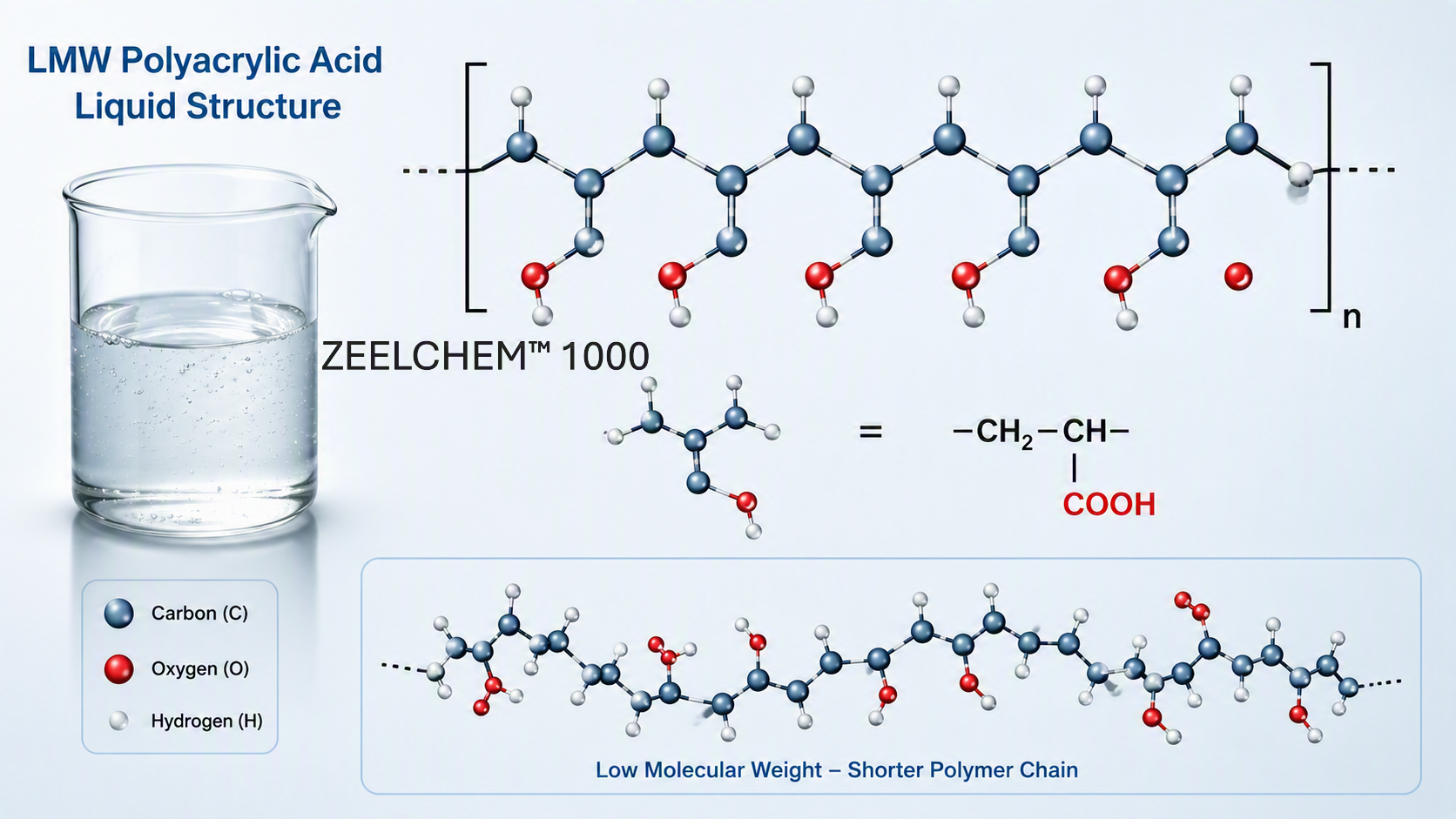
LMW PAA (1,000–5,000 g/mol1,000–5,000 g/mol) prevents this through two primary mechanisms:
- Threshold Inhibition: By interfering with the early stages of crystal nucleation, LMW PAA keeps scale-forming ions in solution even at supersaturated levels.
- Crystal Distortion: If crystals do form, the polymer adsorbs onto their surface, distorting their geometry. This creates "soft," non-adherent scale that can be easily removed through blowdown rather than forming a hard, insulating crust on heat exchanger surfaces.
Practical Application and Operational Advice
To maximize the performance of LMW PAA, facility managers should focus on the following operational parameters:
1. Optimal Dosage Guidelines
Dosage is not "one size fits all." It must be calibrated based on the Langelier Saturation Index (LSI) or the Ryznar Stability Index (RSI) of your circulating water.
- Typical Dosage: Usually ranges from 5 ppm to 20 ppm of active polymer in the circulating water.
- System Stress: In systems with high cycles of concentration (high hardness/alkalinity), dosages on the higher end are required.
- Continuous Injection: PAA must be fed continuously to maintain the threshold concentration. Slug dosing is generally ineffective for scale inhibition.
2. Compatibility with Other Chemicals
LMW PAA is often part of a multi-component formulation. Ensure your treatment program accounts for:
- Biocides: Ensure the PAA is compatible with your oxidizing (e.g., Chlorine/Bromine) or non-oxidizing biocides.
- Corrosion Inhibitors: LMW Polyacrylic Acid - PAA works synergistically with phosphonates and azoles. Always perform a jar test or consult your chemical supplier when changing formulations to avoid precipitation.
3. Monitoring for Success
Don't wait for a system failure to determine if your program is working. Use these indicators:
- Cycles of Concentration (COC): Monitor the ratio of chlorides or conductivity in the cooling water vs. makeup water. If you can maintain higher COC without scaling, your LMW PAA is performing well.
- Approach Temperature: Track the "approach" (the difference between the cold water temperature and the wet-bulb temperature). An increasing approach temperature over time is a classic sign of internal heat exchanger fouling.
Summary Checklist for Facility Managers
| Action Item | Frequency | Goal |
|---|---|---|
| Check Active Levels | Weekly | Ensure residual PAA is within the effective range. |
| Verify Feed Pumps | Monthly | Confirm chemical delivery matches system demand. |
| Monitor Heat Exchange | Continuous | Watch for rising pressure drops or temperature deviations. |
| Review Blowdown Rates | Quarterly | Optimize water waste while maintaining scale control. |